
If you run an online business or plan to scale one, there is a structural concept that often gets overlooked but has a direct impact on traffic, conversions, and even ad approval: product type hierarchy.
It may sound technical, but in practice, it’s simply how you organize your products in a logical, layered structure so both users and search engines can understand them easily.
This article breaks it down in a way that is practical, grounded, and relevant for modern digital businesses.
What Is Product Type Hierarchy?
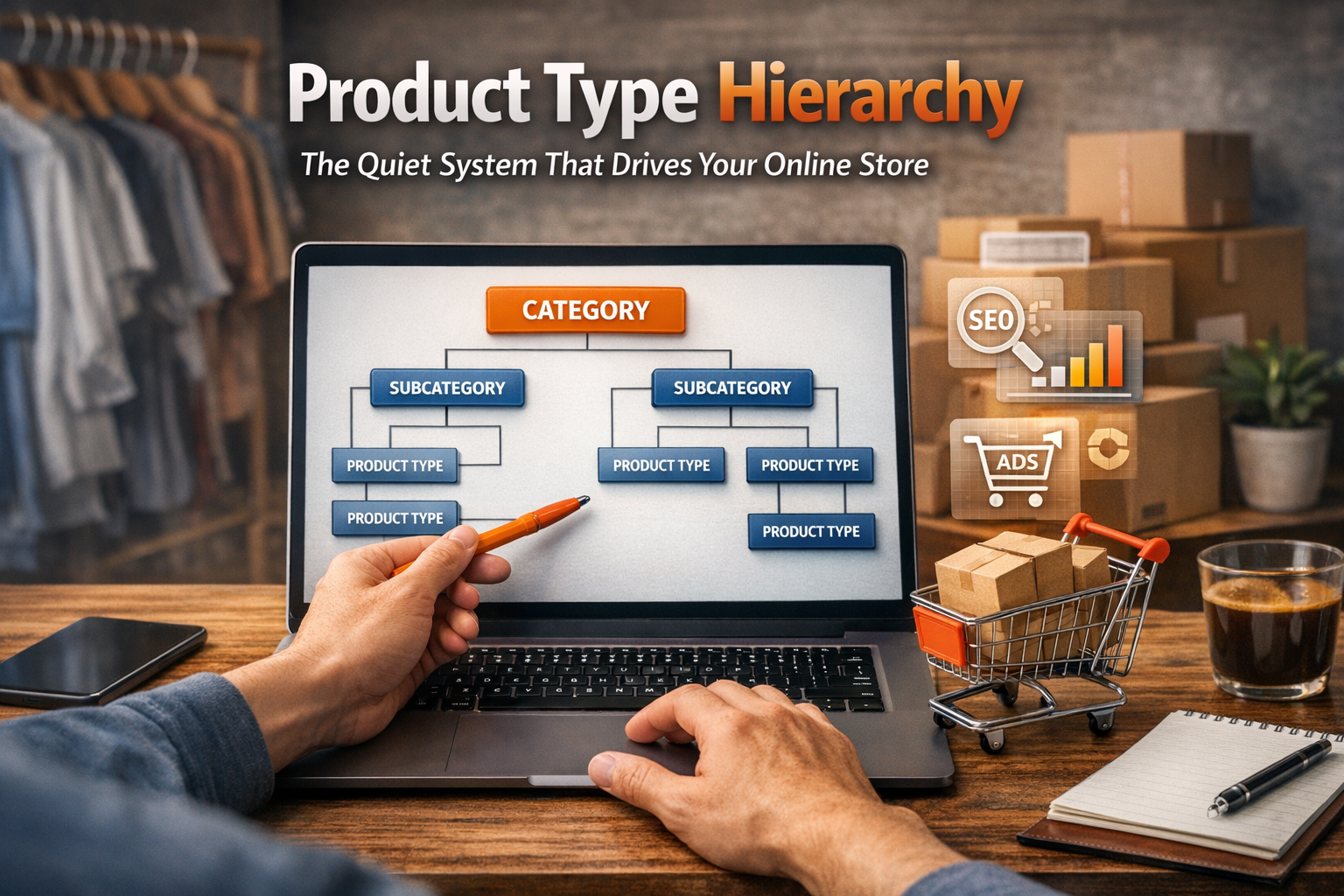
A product type hierarchy is a structured classification of products from general to specific.
Instead of dumping all products into one flat list, you arrange them in levels:
- Category (broad)
- Subcategory (more specific)
- Product type (very specific)
A simple example:
- Fashion
→ Men’s Clothing
→ T-Shirts
→ Oversized Graphic T-Shirts
That layered structure is what we call a hierarchy.
At first glance, it looks like basic organization. But in reality, it influences how search engines crawl your site, how users navigate it, and how platforms like Google Shopping interpret your products.
Why Product Type Hierarchy Actually Matters
Many businesses underestimate this. They focus on ads, creatives, and pricing, but ignore structure. The result is usually inefficiency.
1. It Improves SEO Visibility
Search engines rely on structure to understand your website.
When your hierarchy is clear:
- URLs become more meaningful
- Internal linking becomes stronger
- Keyword targeting becomes more precise
For example:
- /fashion/mens/t-shirts/oversized
This tells Google exactly what the page is about.
Without hierarchy, you end up with:
- /product123
Which carries almost no contextual value.
2. It Makes Navigation Effortless
Users do not want to think too hard when browsing.
A good hierarchy:
- Reduces friction
- Helps users find products faster
- Increases session duration
A messy structure creates confusion. Confusion leads to exits.
3. It Supports Better Ad Performance
If you run ads (especially Google Shopping or Performance Max), product structure affects:
- Feed quality
- Relevance matching
- Approval rates
Platforms prefer clearly categorized products because they can match them better with user intent.
4. It Scales With Your Business
At the beginning, you might only have 20 products.
But what happens when you have 2,000?
Without hierarchy:
- Management becomes chaotic
- Reporting becomes unclear
- Expansion becomes painful
A solid structure early on saves you from restructuring later.
Understanding the Levels of Hierarchy
To apply this correctly, you need to understand each layer.
Category (Level 1)
This is the broadest grouping.
Examples:
- Electronics
- Fashion
- Home & Living
Think of this as the entry point.
Subcategory (Level 2)
This narrows down the category.
Examples under Electronics:
- Smartphones
- Laptops
- Accessories
This is where user intent starts becoming clearer.
Product Type (Level 3+)
This is where specificity matters.
Examples under Smartphones:
- Android Phones
- Gaming Phones
- Budget Smartphones
And even deeper:
- Android Phones → 5G Android Phones → Under $300
The deeper you go, the closer you get to purchase intent.
How to Build a Strong Product Type Hierarchy
This is where most businesses get it wrong. They either overcomplicate or oversimplify.
Start With User Thinking, Not Internal Logic
Do not organize products based on how your warehouse sees them.
Organize based on how users search.
For example:
Wrong approach:
- Category: Inventory Batch A
Correct approach:
- Category: Running Shoes
Use Keyword Research as a Foundation
Hierarchy is not just structure. It is also SEO.
If people search:
- “men oversized hoodie”
Then your hierarchy should reflect that intent.
Not:
- Clothing → Tops → Hoodies
But ideally:
- Men → Hoodies → Oversized Hoodies
Avoid Overlapping Categories
One common mistake is duplication.
Example:
- Sneakers
- Running Shoes
- Casual Sneakers
If the boundaries are unclear, users get confused and search engines get mixed signals.
Each level should have a clear purpose.
Keep It Scalable
Do not build a structure that only works today.
Ask:
- Can this handle 10x more products?
If not, refine it early.
Common Mistakes That Hurt Performance
Understanding mistakes is often more useful than knowing best practices.
1. Flat Structure
All products placed under one category.
Impact:
- Poor SEO
- Difficult navigation
- Weak internal linking
2. Over-Complex Hierarchy
Too many layers:
- Category → Subcategory → Sub-subcategory → Micro-category → Variant
This creates friction.
Users prefer clarity, not depth.
3. Ignoring Search Intent
Using labels that people do not search for.
Example:
- “Urban Upper Garments” instead of “Hoodies”
It may sound unique, but it breaks discoverability.
4. Inconsistent Naming
Switching between:
- T-Shirts
- Tee
- Tshirt
This creates fragmentation in SEO and user experience.
Real-World Example: E-Commerce Clothing Store
Let’s translate this into a practical structure.
Instead of:
- Products
→ Item 1
→ Item 2
A better hierarchy would be:
- Men
→ Tops
→ T-Shirts
→ Oversized T-Shirts
→ Basic T-Shirts - Women
→ Dresses
→ Casual Dresses
→ Formal Dresses
Notice how:
- Each level narrows intent
- Each label matches real search behavior
Product Type Hierarchy in Google Shopping
If you run ads, this becomes even more critical.
Google uses product classification to understand relevance.
There are two key concepts:
1. Google Product Category
This is Google’s predefined taxonomy.
You must align with it as closely as possible.
2. Product Type (Your Custom Hierarchy)
This is where your internal structure comes in.
Example:
- Apparel & Accessories > Clothing > Shirts & Tops > T-Shirts
Your custom version might be:
- Men > Tops > Oversized T-Shirts
Both work together to improve targeting.
The Hidden SEO Advantage Most People Miss
Hierarchy also improves:
Internal Linking
Each category page links to subcategories and products.
This distributes authority across your site.
Crawl Efficiency
Search engines can:
- Discover pages faster
- Understand relationships better
Keyword Clustering
Instead of targeting one keyword per page, you create clusters:
- Category: “Men’s Clothing”
- Subcategory: “Men’s Hoodies”
- Product type: “Oversized Hoodie Men”
This creates topical authority.
How to Audit Your Current Structure
If you already have a store, you do not need to rebuild from zero.
Start with a quick audit:
- Are categories clear and non-overlapping?
- Do URLs reflect hierarchy?
- Are names aligned with search keywords?
- Can a user find any product in under 3 clicks?
If the answer to any of these is no, there is room to improve.
A Practical Framework You Can Apply Today
To simplify everything, use this approach:
- Define your main categories based on broad search demand
- Break them into subcategories based on user intent
- Add product types based on specific queries
- Validate everything with keyword data
- Keep naming consistent and simple
This is not about perfection. It is about clarity and usability.
Final Perspective
Product type hierarchy is not a cosmetic decision. It is infrastructure.
It quietly affects:
- SEO rankings
- Ad performance
- User experience
- Conversion rates
Most businesses only realize its importance when things stop scaling smoothly.
If you build it correctly from the start, it becomes an advantage that compounds over time.
If you ignore it, it becomes technical debt that slows everything down.
There is no need to over-engineer it. A clean, logical, user-focused structure is enough to outperform most competitors who overlook it.