

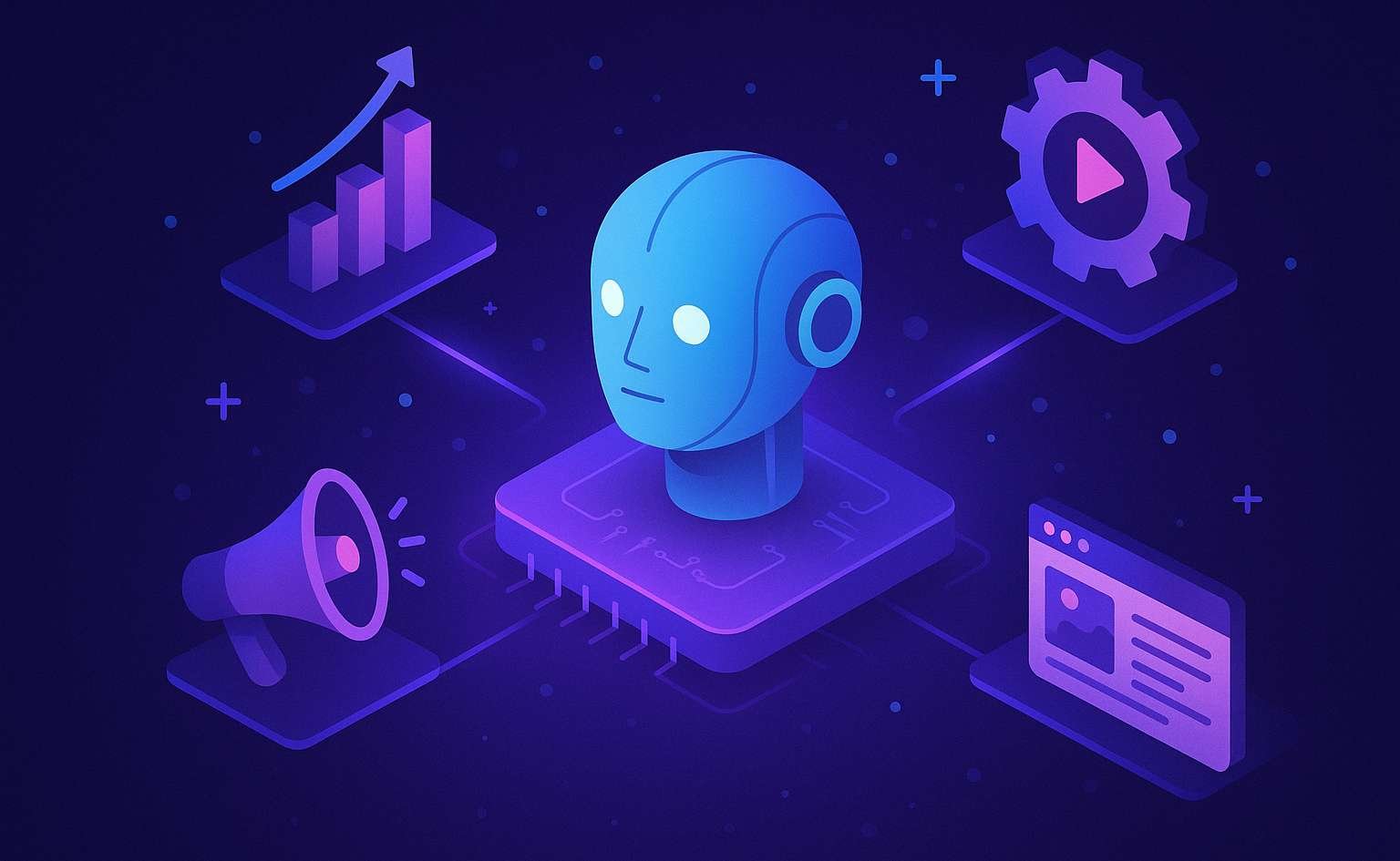
The Robot Revolution Started Without You (And It’s Already Winning)
Let’s get brutally honest for a second: if you’re still doing marketing the way you did it in 2020, you’re basically competing with a horse and buggy while everyone else has Teslas. How AI is transforming digital marketing isn’t some distant future scenario—it’s happening right now, at a pace that’s honestly kind of terrifying and incredibly exciting at the same time.
I’m not talking about simple automation like scheduling social posts (that’s cute, but it’s basically kindergarten-level AI). I’m talking about AI that writes your copy, designs your creative, predicts what your customers want before they know it themselves, and optimizes campaigns in real-time while you sleep. We’re living through the biggest shift in marketing since the internet itself, and most people are still trying to figure out if ChatGPT is a threat or a tool.
Spoiler alert: it’s both, and how AI is changing marketing determines whether you’re disrupting or getting disrupted. The brands crushing it right now aren’t the ones with the biggest budgets—they’re the ones who figured out how does AI affect marketing and adapted faster than their competitors could say “but we’ve always done it this way.”
Whether you’re a solo entrepreneur bootstrapping your first startup or a CMO trying to explain to your board why you need to completely overhaul your marketing stack, this is your playbook. No fluff, no robot apocalypse fear-mongering, just real talk about what’s working, what’s hype, and how to stay ahead of the curve.
What’s Actually Happening: The AI Impact on Marketing (The Good, The Bad, The “Holy Shit”)
The Good: AI Is Making Marketing Actually Smart
Remember when “personalization” meant using someone’s first name in an email? Adorable. Today’s AI can analyze thousands of data points about a customer—browsing history, purchase patterns, time of day, device used, weather in their location—and serve them content that feels like you read their mind.
The numbers don’t lie:
- AI-powered personalization increases marketing ROI by an average of 15-20%
- 80% of businesses using AI for marketing report improved customer engagement
- Conversion rates jump by 30% when AI handles customer segmentation
- Companies using AI for content creation produce 3x more content at 1/5th the cost
How AI is transforming digital marketing in ways that actually matter:
Predictive Analytics That Don’t Suck: Traditional analytics tell you what happened. AI tells you what’s going to happen. Netflix doesn’t just recommend shows you might like—it predicts with scary accuracy what you’ll binge-watch next. That same technology is now accessible to businesses of all sizes.
Hyper-Personalization at Scale: Imagine having a marketing team that creates a unique customer journey for every single visitor to your website. That’s what AI does. It’s like having a million micro-marketers each handling one customer, except they never sleep, never complain, and don’t need healthcare benefits.
Creative That Adapts in Real-Time: AI doesn’t just A/B test anymore—it runs multivariate tests with hundreds of variations simultaneously, learns what works, and automatically shifts budget to winning combinations. While you’re optimizing two versions of an ad, AI is testing 50 and finding patterns you’d never spot.
The Bad: Everyone Sounds the Same Now
Here’s the uncomfortable truth about how AI is changing marketing: we’re entering the age of algorithmic homogeny. When everyone uses the same AI tools trained on the same data, everyone starts sounding the same.
Browse LinkedIn for five minutes. Notice how every post has the same structure, same hooks, same “controversial take” format? That’s AI-assisted content creation creating an echo chamber. The brands that win aren’t the ones using AI the most—they’re the ones using it as a starting point and layering in human creativity that machines can’t replicate.
The risk is real: AI impact on marketing could flatten differentiation rather than enhance it. If every brand uses AI to optimize for engagement, and the AI learns from the same pool of “successful” content, we end up with a marketing monoculture where nothing stands out.
The “Holy Shit”: AI Just Automated Entire Marketing Departments
This is where it gets wild. Jobs that took teams of people are now handled by AI with human oversight:
- Content creation: AI writes blog posts, social copy, ad headlines, and video scripts
- Design: Tools like Midjourney and DALL-E create professional graphics in seconds
- Media buying: Programmatic AI handles ad placement, bidding, and optimization
- Email marketing: AI writes, sends, and optimizes email campaigns autonomously
- Customer service: Chatbots handle 70-80% of customer inquiries without human intervention
Before you panic about job security, here’s the nuance: AI isn’t replacing marketers—it’s replacing marketers who refuse to learn how to use AI. The new skill isn’t writing copy or designing graphics. It’s knowing how to prompt AI, when to trust it, and when to override it with human judgment.
The AI Marketing Trends That Are Actually Worth Your Attention
1. Conversational AI That Doesn’t Make People Want to Throw Their Phone
Chatbots used to be the worst part of customer service—those “Sorry, I didn’t understand that” loops of hell. Modern conversational AI powered by models like GPT-4 can handle complex queries, understand context and sarcasm, and actually solve problems.
Real-world impact: Drift increased lead qualification by 67% using conversational AI. Sephora’s chatbot handles millions of beauty consultations monthly, with satisfaction scores matching human advisors. These aren’t basic FAQs—they’re sophisticated conversations that guide customers through entire purchase journeys.
The trend: Conversational AI is moving beyond customer service into sales, onboarding, and even strategic consultation. The brands winning are the ones treating AI chat as a channel, not a cost-saving measure.
How to capitalize: Implement AI chat that actually helps. Give it personality, arm it with real knowledge, and use it to capture leads while providing genuine value. If your chatbot just tells people to email support, you’re doing it wrong.
2. AI-Generated Content That Doesn’t Suck (Mostly)
Content marketing used to require expensive writers, designers, and videographers. Now? AI handles the bulk work while humans focus on strategy and refinement.
What’s working:
- AI writing assistants help create first drafts 5-10x faster
- Image generators produce unique visuals without stock photo cringe
- Video AI creates personalized videos at scale (think thousands of custom versions)
- Voice synthesis makes podcasts and audiobooks without recording studios
The catch: AI-generated content needs human editing, fact-checking, and that intangible “spark” that makes content memorable. The workflow isn’t “AI creates, we publish”—it’s “AI creates, we refine, we enhance, we publish.”
Case study: Forbes uses an AI platform called Bertie to generate article drafts and suggest headlines. Human journalists then refine and publish. Result? 2x content output with the same team size, and quality actually improved because writers spend time perfecting rather than starting from scratch.
The trend: Hybrid content creation where AI handles the heavy lifting and humans add expertise, personality, and strategic direction. Companies that master this workflow dominate content marketing while competitors are still arguing about whether AI content is “authentic.”
3. Predictive Lead Scoring That Actually Predicts
Traditional lead scoring was basically guessing with extra steps. AI lead scoring analyzes hundreds of behavioral signals to predict which leads will convert with scary accuracy.
How AI is transforming digital marketing in B2B sales:
- AI identifies “hidden” buying signals humans miss
- Predicts when leads are ready to buy (not just whether they might)
- Scores leads based on actual conversion probability, not vanity metrics
- Automatically nurtures low-score leads until they’re sales-ready
Real results: Companies using AI lead scoring see 50% more sales-ready leads and 30% reduction in cost per acquisition. Sales teams stop wasting time on tire-kickers and focus on deals that actually close.
The trend: Lead scoring is evolving into “revenue intelligence”—AI that doesn’t just score leads but orchestrates entire revenue operations, from first touch to closed deal to upsell opportunities.
4. Dynamic Pricing That Maximizes Revenue (Without Looking Shady)
Airlines and Uber have been using dynamic pricing for years. Now AI makes it accessible to any business, adjusting prices in real-time based on demand, inventory, competition, and customer willingness to pay.
The ethics: Done poorly, dynamic pricing feels manipulative. Done right, it’s personalized value—like offering discounts to price-sensitive customers while charging premium for those who value convenience.
Examples:
- E-commerce brands using AI to optimize pricing by customer segment
- SaaS companies personalizing plans based on usage patterns
- Service businesses adjusting rates based on demand and capacity
The trend: Moving beyond simple dynamic pricing to “value-based pricing” where AI determines what’s fair for both customer and business, maximizing lifetime value rather than just transaction value.
5. AI-Powered Creative Testing (The Death of Creative Directors’ Egos)
Creative used to be subjective—someone senior said “I like this one” and that’s what ran. Now AI tests creative at a scale that makes human judgment look quaint.
How it works:
- AI generates hundreds of ad variations (different images, copy, CTAs, layouts)
- Serves them to micro-audiences
- Identifies winning patterns
- Automatically creates new variations combining successful elements
- Rinses and repeats infinitely
Real data: Meta’s AI-powered dynamic creative optimization improves ROAS by 30-50% on average compared to static ads. Google’s responsive search ads using AI outperform traditional ads 90% of the time.
The controversial part: This undermines traditional creative philosophy. Instead of the “big idea” driving campaigns, it’s algorithmic iteration finding what works. Creatives hate this. Performance marketers love it. The truth? Both approaches matter, and smart brands use AI to test executions while humans create the strategic concepts.
How Does AI Affect Marketing Teams? (The Uncomfortable Conversation)
Let’s address the elephant in the room: the AI impact on marketing jobs is real, significant, and not going away.
Jobs AI Is Eliminating (Be Real About This)
- Junior copywriters churning out routine content
- Basic graphic designers making standard social graphics
- Media buyers manually adjusting bids and placements
- Data analysts creating basic reports and dashboards
- Entry-level researchers gathering competitive intelligence
If your job is repetitive, data-driven, and doesn’t require strategic thinking, AI is coming for it. Not eventually. Now.
Jobs AI Is Creating (The Silver Lining)
- AI prompt engineers who know how to get the best outputs from AI tools
- AI marketing strategists who blend human insight with machine capabilities
- AI ethics specialists ensuring responsible AI use in marketing
- Hybrid creators who use AI tools to amplify their creativity
- AI systems integrators who connect marketing tools into unified systems
The marketers thriving aren’t the ones fighting AI—they’re the ones becoming AI-augmented superhumans. One person with AI can do the work of an entire team from five years ago.
The Skills That Matter Now
Technical fluency: You don’t need to code, but you need to understand how AI tools work and integrate.
Strategic thinking: AI handles execution, humans handle strategy. “Why” and “what” matter more than “how.”
Ethical judgment: Knowing when AI suggestions are brilliant vs. when they’re biased, manipulative, or just wrong.
Creative direction: Guiding AI rather than being guided by it. Using it as a tool, not a crutch.
Data interpretation: AI generates insights, but humans decide what they mean and how to act on them.
AI Marketing Tools You Should Actually Be Using (Not Just Hyping)
Content Creation Stack
Copy.ai / Jasper: AI writing assistants that don’t write for you—they write with you. Generate outlines, overcome writer’s block, create variations. Don’t publish raw AI output; use it as your starting point.
Midjourney / DALL-E: Visual creation that’s scary good. Generate unique images, mockups, and concepts in minutes. The learning curve is steep but the payoff is huge.
Descript / CapCut: Video editing with AI transcription, cloning, and editing. Edit video by editing text. It’s black magic.
Analytics and Optimization
Seventh Sense: AI email send-time optimization that increases open rates by 10-20% by delivering emails when each subscriber is most likely to engage.
Optimizely / VWO: AI-powered experimentation platforms that run smarter tests and identify winning variations faster.
Crayon: Competitive intelligence AI that tracks competitors and surfaces insights you’d never find manually.
Customer Experience
Intercom / Drift: Conversational marketing platforms with AI that actually works. Lead qualification, customer support, and engagement in one tool.
Gong / Chorus: Revenue intelligence platforms that analyze sales conversations and identify what messaging works.
Dynamic Yield: Personalization engine that creates unique experiences for every visitor based on hundreds of data points.
Creative and Design
Canva Magic Studio: AI-powered design tools integrated into Canva. Background removal, magic erase, text-to-image—all stupid-simple to use.
AdCreative.ai: Generates ad creative specifically optimized for performance. Feed it your brand assets, get hundreds of ad variations.
Runway ML: AI video editing that feels like science fiction. Generate video from text, edit video with words, create effects that used to require Hollywood budgets.
How to Build Your AI Marketing Strategy (Without Losing Your Soul)
Step 1: Audit Your Current Marketing (Brutally Honestly)
What tasks are you doing that AI could handle better, faster, or cheaper? Make a list. Be ruthless. If it’s repetitive, data-driven, or doesn’t require unique human judgment, it’s probably AI-able.
Step 2: Start Small, Scale Smart
Don’t try to AI-ify your entire marketing operation overnight. Pick one area:
- Use AI writing assistants for blog outlines
- Implement chatbots for initial customer inquiries
- Try AI ad optimization on one campaign
- Use predictive analytics for one customer segment
Test, measure, learn. If it works, expand. If not, iterate or pivot.
Step 3: Invest in Training (Seriously)
Your team needs to learn AI tools like they learned social media a decade ago. Budget for courses, workshops, and experimentation time. The ROI on AI training is easily 10x within the first year.
Step 4: Maintain Human Oversight
AI makes mistakes. It hallucinates facts, misses context, and sometimes produces output that’s technically correct but strategically stupid. Every AI output needs human review before it touches customers.
Step 5: Define Your Ethical Boundaries
Where do you draw the line on AI personalization? How transparent will you be about AI use? What data will you use and not use? Answer these questions now before they become PR crises.
The Future Is Already Here (You’re Just Not Paying Attention)
How AI is changing marketing isn’t a future trend—it’s the present reality. The brands dominating in 2025 are the ones who embraced AI in 2023. The ones still debating whether to adopt AI? They’re the ones wondering why their competitors are crushing them with smaller teams and budgets.
Here’s the uncomfortable truth: the AI impact on marketing means traditional marketing skills are becoming table stakes rather than differentiators. Everyone will have AI tools. Everyone will use automation. Everyone will have access to the same capabilities.
The competitive advantage isn’t the AI—it’s how you use it. It’s the strategy behind the tools. It’s the creativity that guides the algorithms. It’s the human judgment that knows when to trust the machine and when to override it.
Your AI Marketing Action Plan (Stop Reading, Start Doing)
This Week:
- Sign up for one AI writing tool (most have free trials)
- Use AI to create three pieces of content
- Compare the time investment vs. traditional methods
This Month:
- Audit your marketing stack for AI opportunities
- Implement one AI tool in one area of your marketing
- Measure the impact quantitatively
This Quarter:
- Expand AI usage to 3-5 areas of your marketing operation
- Train your team on AI tools and best practices
- Develop your AI ethics and transparency guidelines
This Year:
- Build AI into your core marketing strategy
- Hire or train AI-native marketers
- Measure ROI and reinvest in what works
The marketers winning with AI aren’t waiting for perfect solutions or clear best practices. They’re experimenting, failing fast, learning quickly, and staying ahead of the curve.
The Bottom Line: Adapt or Get Left Behind
How AI is transforming digital marketing isn’t a question anymore—it’s a fact. The only question is whether you’re going to be a driver of that transformation or a casualty of it.
The good news? You don’t need to be a tech genius or have a massive budget. You need curiosity, willingness to experiment, and the humility to learn new tools. The AI revolution in marketing is weirdly democratic—small brands with smart AI strategies are beating big brands with traditional approaches.
How does AI affect marketing in the long run? It separates marketers who think from marketers who just execute. It rewards creativity, strategic thinking, and adaptability. It punishes complacency, ego, and resistance to change.
So here’s your choice: master AI and multiply your marketing impact by 10x, or stick with traditional methods and watch your competitors eat your lunch while using half the resources.
The robot revolution already started. The question isn’t whether you’ll join it—it’s whether you’ll lead it or get run over by it.
Ready to go deeper? Start experimenting with AI tools this week. Pick one area of your marketing, choose an AI tool, and just try it. The best way to understand the AI impact on marketing is to experience it firsthand. No more research paralysis—just start.


